Table of Contents
- Introduction to Proof Testing
- Advancements in Non-Destructive Testing
- Integration of AI in Structural Assessment
- Case Study: Robotic Inspection of Bridges
- Combining 3D Scanning with Finite Element Analysis
- Benefits of Modern Proof Testing Techniques
- Challenges and Future Directions
- Conclusion
Ensuring the stability and safety of our built environment has never been more important. With ever-increasing demands on infrastructure, civil engineers have turned to proof testing Houston TX that leverage advanced technology to safeguard the integrity of structures. These innovations enable industry professionals to identify material weaknesses, mitigate risks, and extend the life of critical assets, all while reducing the inconvenience and hazards associated with traditional inspection methods.
From aging bridges to newly erected high-rises, advances in structural proof testing are providing peace of mind for engineers, city planners, and the public alike. By harnessing a variety of cutting-edge tools and methodologies, today’s testing regimes not only provide more accurate data but also increase efficiency, limit disruptions, and enhance safety standards. Understanding these advancements is vital for anyone involved in construction, asset management, or infrastructural oversight.
Introduction to Proof Testing
Proof testing is the practice of applying deliberate, controlled loads to structures to verify their capacity to withstand operational and extreme loads. This approach is foundational to engineering, ensuring that weaknesses are identified before catastrophic failure. By rigorously verifying structural integrity through simulation of real-world conditions, proof testing reduces the risk of unexpected incidents and ultimately protects public safety and long-term investments.
Advancements in Non-Destructive Testing
The field of Non-Destructive Testing (NDT) has experienced remarkable innovation, introducing sophisticated tools that assess structural health without causing any harm or requiring disassembly. Ultrasonic Pulse Velocity (UPV) is now regularly used to probe the internal cohesion of concrete, revealing voids and microfractures invisible to the naked eye. Ground Penetrating Radar (GPR) enables engineers to map subsurface features, detect rebar placement, and identify corrosion with accuracy previously unattainable.
These NDT methods not only minimize risks to assets during inspection but also allow for regular, even continuous, monitoring. Real-time data acquisition helps teams make timely maintenance decisions, reducing the likelihood of unexpected closures or failures. Considerable advancements in sensor technology have also improved data clarity and reliability.
Integration of AI in Structural Assessment
Artificial Intelligence (AI) is redefining how engineers interpret large volumes of structural data. Instead of relying solely on manual review, AI systems employ machine learning algorithms to scan images, vibration patterns, and even acoustic signatures. They quickly flag anomalies, such as spalling concrete or fatigue cracks, enabling earlier interventions and smarter allocation of resources. With the growing availability of historical and real-time data, predictive maintenance schedules are now perfecting themselves, increasing reliability across bridges, buildings, and industrial assets.
Major industry players are increasingly turning to cloud-based AI platforms to synthesize multisource inputs, visual, thermal, and hyperspectral, ensuring no early signs of distress escape attention. This integration is described in detail by organizations like Puppet AI Infrastructure Management.
Case Study: Robotic Inspection of Bridges
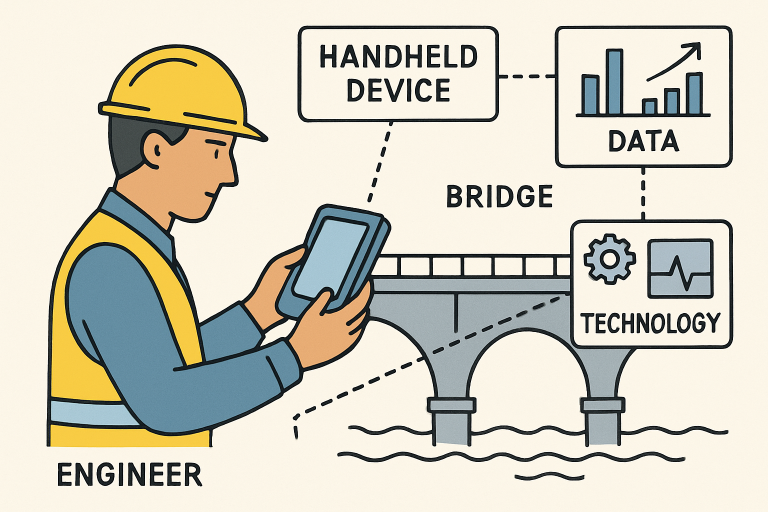
Bridge inspections have historically been hazardous and resource-intensive. The introduction of robotics, equipped with an array of smart sensors and deep learning modules, is transforming this field. For example, autonomous robotic platforms can now traverse complex and dangerous bridge structures to perform high-resolution ultrasonic scans and use computer vision to pinpoint rust, fatigue cracks, or weld imperfections.
One recent application involved a remote-controlled robot fitted with ultrasonic phased arrays and AI analytics tools, which could distinguish between harmless surface blemishes and critical defects in steel bridge decks. The result was a significant reduction in downtime and less exposure of human inspectors to risk, while data accuracy far exceeded that of traditional hands-on methods.
Combining 3D Scanning with Finite Element Analysis
3D laser scanning and Finite Element Analysis (FEA) are being fused to create hyper-accurate representations of infrastructure. By capturing detailed three-dimensional ‘point clouds’ of a structure, engineers can generate finite element models that simulate a vast array of load scenarios and environmental conditions. The relation between actual scanned data and theoretical simulations enables tailored reinforcement strategies, targeted retrofits, and comprehensive inspection reports.
This integrated method is especially valuable for large, aging networks of assets where historic documentation may be lacking or incomplete. It lays the groundwork for advanced digital twins and facilitates ongoing digital monitoring. As the world embraces smart infrastructure, this combination is quickly becoming standard practice in large-scale engineering projects.
Benefits of Modern Proof Testing Techniques
- Enhanced Accuracy: Sensors and digital tools provide granular, quantifiable data that reduces guesswork and oversight.
- Efficiency: Robotic and AI-based systems accelerate the inspection process and minimize disruption to operations or traffic.
- Safety: Non-invasive assessments reduce the risk to both assets and personnel, especially on challenging structures such as suspension bridges or cooling towers.
- Predictive Maintenance: Early detection builds a solid foundation for preventive action, maximizing the longevity and reliability of infrastructure assets.
Challenges and Future Directions
Despite the promise of modern proof testing, some barriers hinder broader adoption. High upfront costs for hardware, software, and training pose challenges, particularly for smaller organizations or municipalities. Furthermore, the sheer volume of data generated creates new obstacles in data storage, synthesis, and secure sharing. Ongoing research and development are critical to addressing these pain points, standardizing best practices, and reducing costs through innovation and scalable solutions.
In the future, we can expect further convergence between IoT, AI, and simulation tools, ultimately democratizing high-tech structural integrity management. Increased industry cooperation and government standards will help drive accessibility and foster public trust in our critical infrastructure.
Conclusion
The evolution of proof testing methodologies is fundamentally reshaping how society approaches the challenges of infrastructure maintenance, repair, and lifecycle management. Through the powerful fusion of non-destructive testing, AI-driven analysis, and advanced simulation, stakeholders are achieving better outcomes for the public, for asset owners, and for the environment. Embracing these modern techniques is no longer a luxury but a necessity in our fast-changing world.